The Edge, Not the Script
Adventure used to mean something. A spark, a step into the unknown, the edge where…
Read more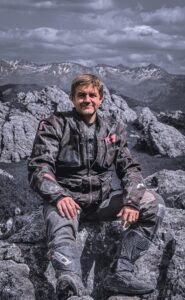
What prompts a person to abandon the familiar routines of home, swing a leg over two wheels, and set off toward the edge of the map?
And what, at that very same moment, holds us back?
For my part, I’ve come to see a paradox at work.
We are driven toward two seemingly incompatible desires.
On the one hand, we hunger—almost desperately—to expand the boundaries of our personal map of reality. To do that, we must inevitably confront the Great Unknown: the high-voltage uncertainty, the mistakes, the risk.
On the other hand, our instinctive self demands assurance. When we choose to step into that uncertainty, we want to know—in some deep interior way—that we can handle whatever comes. Even if the road narrows to a razor’s edge, even if circumstances tilt against us, the losses must remain within a range we can accept.
It is precisely along that edge—between danger and control—that the most compelling stories are born.
And it is here that we receive that unmistakable hormonal jolt—dopamine, noradrenaline, or some alchemical mixture of the two—as a kind of reward for having steered our way out of difficulty, crossed the threshold of adversity, and come out the other side intact.
Perhaps it is something ancient that moves within us.
For millions of years, hunter-gatherers gained their advantage by pushing the boundaries of the known.
Maybe we’re simply continuing the same long, silent tradition—one throttle twist at a time.
There is another force at work—quiet, but powerful—and that is aesthetic delight.
Immanuel Kant described it as the ability to take pleasure in a thing or a landscape without the urge to possess it. We set out on the road for the sake of novelty, to witness new horizons, to meet a different culture face to face. It is a deep, primal need untouched by notions of conquest or consumption.
Of course, there are others who prefer certainty, well-worn patterns, and safety—those who laid the foundations of our civilization.
But I’ve come to accept that within me lives the spirit of a wild nomad. That is my nature.
I find the release of my inner drive—my passionarity—in motorcycle travel. It is my path: not an aggressive one, not a path of taking, but a path of exploration.
When I scroll through social-media posts, videos, and all those “reels” about motorcycle travel, I’m seized by a peculiar feeling.
The person who is just about to set out often has a wildly distorted sense of what reality will be. I’ve seen this both in my own missteps and in the many new riders I’ve watched from the sidelines.
It’s precisely this contrast—the polished image versus the lived reality—that pushed me toward thinking, questioning, and trying to build some sort of framework.
The simple answer seems obvious enough: you need a readiness to act under high uncertainty, and a clear sense of where the boundary of acceptable risk lies.
But even the most superficial look at these points opens whole strata of questions—questions that can’t and shouldn’t be answered exhaustively. What matters is that they set the direction of travel:
How do you gauge your real abilities and skills while still in the planning stage?
How do you recognize risks in advance and make a sound decision in the moment?
And what concrete steps can you take to improve the quality and the value of the experience you’re seeking?
At some point it dawned on me that what fascinates me about motorcycle travel isn’t just the riding itself, but the thinking that accompanies it—the steady unfolding of new understanding. I realized that simply heading out wasn’t enough; I needed to build a methodology.
The two questions I chose as my compass points were these:
What can make our motorcycle journey as meaningful and as enjoyable as possible?
And what specific actions must we take to reach that result?
That was the beginning of a deep dive into the study of motorcycle biomechanics, human anatomy, modern training methods, the theory of managing cumulative fatigue, as well as ultralight gear and the experiences of other riders.
I’m 52 now. I’ve been on a motorcycle since I was nine. I have competitive experience behind me—motocross, hard enduro—and hundreds of thousands of kilometers on the odometer. I’m no longer in the physical shape required to race, but I’ve discovered an equally compelling world: off-road travel.
I understand perfectly well that most people don’t have the time to wade through all these scientific subtleties. So I set myself a task: to distill the most valuable insights from this body of knowledge and create an effective preparation system for motorcycle travelers. I began coaching, taking real joy in my students’ success, seeing their photos from the Himalayas, Africa, or Latin America.
I can’t say I’ve completed any kind of universal, “finished” system—I’m still very much on the road.
But I already see value in the experience and knowledge I’ve gained, and I’m ready to share it with those who need it.
I keep hearing the same naïve questions: “How long will it take me to learn off-road riding? Two weeks? A month?” Or, “Can I set off on my first big motorcycle journey in my very first season?”
Manufacturers want to sell motorcycles, and their ads are built to create an illusion of simplicity. People dislike complications. But it’s worth understanding what’s really being offered: a tool, and the illusion that its use is effortless. Acquiring real skill is a far more complex undertaking.
So how long does it take to learn off-road riding?
There’s no simple answer—only a hard truth. Two weeks won’t do it. A month won’t either. You won’t feel even moderately confident off-road in that time. Everything depends on your physical condition, on how quickly your brain absorbs motor patterns—your neuroplasticity—on joint mobility, and on a dozen other factors. But more important still, and something I learned the hard way, is this: the skill of off-road riding is not the same as the skill of organizing a motorcycle journey that allows you to enjoy the experience rather than merely derive moral satisfaction from overcoming hardship.
Perhaps the most honest answer is this: you will never be 100% ready.
But that shouldn’t stop you.
You’ll need to learn to assess risks and take responsibility for your decisions. Only then can you act freely, without leaning on the false promise of guaranteed success.
I was a confident fool.
I had a solid background in off-road riding, had competed in races—motocross first, then hard enduro. With that kind of history, setting out on my first autonomous motorcycle journey, I thought: “What could possibly go wrong? I know how to ride.”
Right away I decided: two weeks, wild camping, a tent, nights in mountain huts. And yes—my skills did save me more than once, helped me stick to the plan. But you know what? The only pleasure I felt was the grim satisfaction of being able to overcome every difficulty. That wasn’t what I wanted from a vacation. I wanted to enjoy myself, not just endure.
I had planned short daily distances, packed my gear according to advice from “popular motorcycle adventurers”—and still:
I hauled along a mountain of useless junk.
I barely understood how to organize my camp and rest so that I could actually recover.
Fatigue was piling up at a murderous pace.
This was Greece, late October into early November. Warm days, but at night the mountain temperatures dropped well below freezing. My competitive athletic conditioning was the only thing keeping me upright, and even that couldn’t keep me from burning out—mentally and physically—with alarming speed.
It turned out to be the best lesson in humility I could have asked for. It forced me to rein in my own ego. There was no room for a warm sleeping bag on my overloaded bike, so I could camp only at low elevations. I relied heavily on the high-mountain emergency huts I had marked on the map. My skills got me there on time. But any delay…
Any delay could have cost me my life. Freezing to death in the mountains that time of year is not some abstract danger—it’s a very real possibility if you stray off the track or, worse, get injured.
That journey taught me to temper my ego and understand something simple and important: I don’t want to merely indulge in my ability to survive risk.
I want to get the most joy out of the road.
I came to see that to get the most out of a trip you must attend to several dimensions. There are no universal answers — this is both craft and art. But from experience, both lived and borrowed, I have developed approaches and tactical habits that keep me fit and in good spirits throughout the route:
Before I move on to these items I always ask myself the first and most important question:
What do I actually expect from the motorcycle journey? What do I want?
For example, if I want the maximum of adventure and spontaneity, I must accept fairly strict demands on terrain and equipment. I must soberly assess where I stand. Spontaneity is permissible in comfortable surroundings, but you probably don’t want to find yourself alone amid sand dunes under a blazing sun, or in winter above the Arctic Circle, and rely on luck — unless you are a mythical superhero or, frankly, an irrational person. Environment, equipment, and my skills together determine the level of adventure and spontaneity I can responsibly permit myself.
So my personal approach to planning a motorcycle journey begins with closing my eyes and letting the imagination run.
From there we work step by step through what is required to travel by motorcycle deliberately and with pleasure.
If we agree that the true value of motorcycle travel lies in spontaneous and authentic experience, then we must also understand this: the possibility of such experience depends first and foremost on our level of preparation.
A simple rule applies here:
The higher your level of preparation, the greater the uncertainty and spontaneity you can safely allow yourself.
Another key factor is an awareness of risk and a willingness to accept it — and the ability to assess risk accurately comes only with experience.
This is the essence of the work we do at our off-road motorcycle school. Our task is not to promise quick victories or create a false sense of confidence. Our goal is to give you the methods that allow you to progress as quickly and effectively as possible, while putting your effort in the right direction.