The Roadmap to Becoming an Off-Road Rider
Off-road riding is one of the most rewarding forms of motorcycling — but it also places unique demands on your body, your technique, and your mindset. Many riders try to progress through trial and error, relying on scattered tips from the internet or simply hoping that “experience” will naturally turn into skill. It rarely works this way.
To develop true confidence, safety, and long-term enjoyment, you need a structured and thoughtful approach — one that builds your skills step by step, without unnecessary frustration or bad habits.
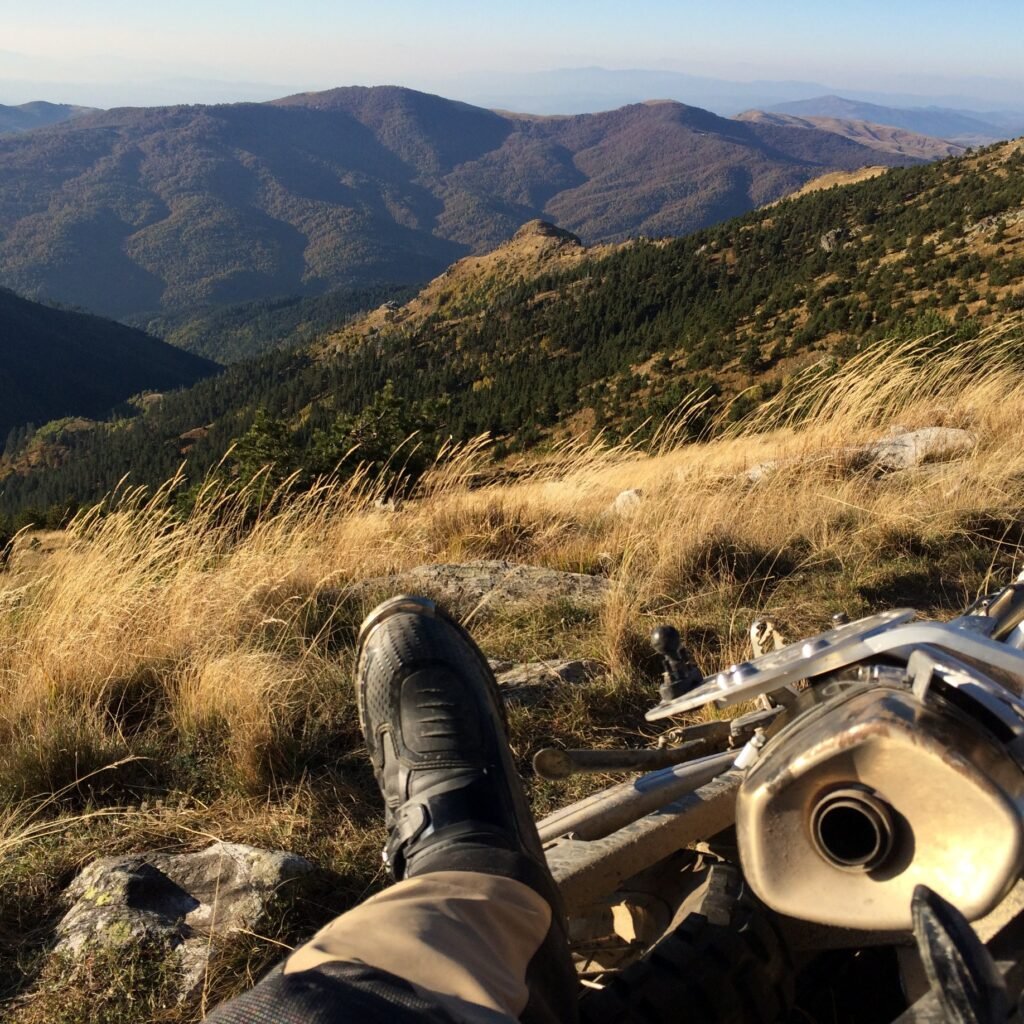
This roadmap outlines how we structure the learning process to help you ride confidently, ride longer, and truly enjoy every moment on the bike.
It explains the logic behind our training system, the progression of stages, and the core principles that make off-road riding both safer and more enjoyable.
How long does it take?
Skill development in off-road riding is a long-term process. The basic foundation can be formed in a matter of weeks, but stable, dependable off-road skills typically require one to two full seasons of consistent practice. This is normal — the body needs time to integrate new movement patterns.
You can read more about the underlying training principles and skill-acquisition timelines here → Conscious Skill Acquisition: How a Cognitive Approach Enhances Motor Learning
What you’ll find here is not a detailed technique guide, but a clear overview of how we approach rider development:
– laying the right physical and biomechanical foundation,
– building essential off-road skills in the correct order,
– and gradually applying them in real terrain, from training routes to long adventure journeys.
Our goal is simple:
to help you develop as efficiently as possible, avoid common pitfalls, and gain the ability to ride off-road for many seasons — with confidence, comfort, and pleasure.
From Buying Your First Bike to Solo Adventures
Here we’ll outline the general stages of becoming a competent rider and the path we consider the most effective. We won’t dive deep into specific challenges here — we’ll simply highlight them and explore each in later articles.
Choosing a Motorcycle: The First and Biggest Temptation
This is the stage where most new riders make their first big mistakes: buying a bike that fits their idea of what an ADV rider or moto-traveler should look like, rather than a motorcycle that will actually help them progress quickly and safely.
The bike you dream of may be ideal for the journey ahead — but not for the first steps you need to master.
It’s hard to overstate how important this decision is. The wrong bike can become a barrier you simply can’t overcome on your path to skill development.
If you’re serious about learning to ride and want to approach training properly with our help, we’ll gladly assist you in choosing the right motorcycle. → Learn more
Your first bike should serve your progress — not your image.
Understand Your Body
The Core Principle (Road vs. Off-Road)
On the road:
A well-balanced bike essentially carries you, and your main task is simply not to interfere. Having a motorcycle license only means you meet the basic safety requirements for yourself and others — it does not mean you’re a skilled rider.
You can twist the throttle and hit 300 km/h on a straight line; the bike will remain stable at that speed, but that says nothing about your ability to maneuver, handle complex terrain, or make quick, correct decisions. On the road, the bike mostly does the work for you.
Off-road:
The moment you leave the pavement, the motorcycle depends much more on the rider — but not in the sense of constant steering inputs. Rather, off-road riding requires you to work in harmony with the bike: use your body to sync with the bike’s natural movements, maintain dynamic balance, and position yourself so the suspension, geometry, and front wheel can do their job. Your activity is physical and anticipatory — you’re actively supporting the bike’s dynamics, not forcing its motion.
The core principle, then, remains:
“Let the bike do its job — don’t over-control it.”
Off-road riding places far greater demands on your body: posture, balance, cornering technique, and overall coordination all become essential. Understanding how your body and the motorcycle function as a single system is crucial — that awareness lets you design effective training instead of relying on random practice. Our goal is to give you the foundational knowledge for conscious riding and purposeful training.
Here we’ll later dive deeper into the nuances of off-road biomechanics.
Beginning Off-Road Training (The Start Module)
Laying a proper foundation for understanding off-road riding technique is arguably the most important stage of your entire development. At this point, it’s essential to let go of the myths and misconceptions about off-road riding that fill the internet, social media, and moto-blogging space.
The foundation — is your body.
Your muscles, ligaments, and joints must be prepared to work with the motorcycle. This phase is often underestimated: many assume the body will simply “adapt with time” without any focused preparation. That may happen — but if you’re 40+ and have no background in motorsport (even if you regularly go to the gym), there’s a high chance your body will rely not on its primary movement patterns, but on compensatory mechanisms.
In the long run, this often leads to pain and a whole range of physical problems. Proper biomechanics is critically important for off-road riding if you want to ride for many years and enjoy the process.
The Riding Stance
Incorrect posture can reduce the effectiveness of your input by a factor of four or more.
Stance is perhaps the most important aspect for any off-road rider. In practice, stance correction continues throughout a rider’s entire journey. Proper stance activates the correct muscle chains. Research shows that the effectiveness of control inputs can differ by a factor of four to five depending on posture — and this directly affects your reaction time and, consequently, your safety.
Longitudinal Balance (Acceleration and Braking)
This is where many beginners fall for the illusion of simplicity. It seems straightforward: I already learned this in motorcycle school when preparing for my license.
In reality, acceleration and braking technique is a deep topic. But here’s a simple test (especially for the overly confident):
Find a dirt road with climbs and descents, or a motocross track, and try riding a full lap standing, holding the handlebars with one hand, accelerating and braking.
If you can complete a lap like this, congratulations — you likely have a solid stance and a well-developed weight-shift pattern for acceleration and braking.
Lateral Balance
This is where most problems appear. When we walk or stand, the muscle patterns we use to maintain balance are fundamentally different from those required in off-road riding.
Body position and muscular engagement on the bike more closely resemble patterns natural for gorillas or chimpanzees — natural for them, but something we have to learn deliberately. Understanding the biomechanics behind this process is essential to build from the very start.
Off-Road Cornering
You can write endlessly about technique, but that alone won’t improve your skill. Cornering is an area where having an experienced coach is absolutely crucial.
Summary: What the Base Module Includes
The foundational module consists of the following core elements:
- basic biomechanics and understanding how the body works on the motorcycle (developing correct motor patterns)
- establishing proper body position in both standing and seated riding
- longitudinal balance (acceleration and braking)
- lateral balance
- basic off-road cornering technique
Minimum Essential Skills: The Off-Road Rider Course
Once you’ve formed the initial Cognitive Understanding — the basic awareness of body position on the motorcycle and the core principles of balance — you enter the subsequent practice phase, which is one of the most engaging stages of your skill development.
1. Cognitive Stage
Focus: Understanding the Movement. The learner focuses on what is required and how to produce the movement. Performance is marked by large and frequent errors, high variability, and requires maximum conscious attention and cognitive effort.
2. Associative Stage
Focus: Refining the Pattern. Errors become fewer and less severe. The movement pattern is stabilized and optimized for efficiency. The learner begins to associate sensory information with movement outcomes. Performance is becoming more coordinated, consistent, and requires less deliberate thought.
3. Autonomous Stage
Focus: Automatic Execution. The skill is performed with minimal or no conscious attention. The motor program is robust, highly resistant to environmental stressors, and reaction time is fast. Cognitive resources are freed up to focus on strategy or external factors.
At this point, your movement understanding begins to stabilize, and we transition to practicing the essential skills you’ll need for confident off-road riding.
The base course is structured into separate modules, each aligned with the key goals you set for yourself. For example:
- Safety
- Speed
- Endurance (managing cumulative fatigue)
- and more.
In addition to the core modules, we also offer specialized seminars and masterclasses with well-known motorcycle travelers and professional riders.
Building a Training Path That Fits Your Goals
Training is not just about drills — it’s about understanding how the body works with the motorcycle.
This structure allows us to tailor the training process to the specific goals you set for yourself — whether it’s relaxed Sunday rides with friends on light enduro bikes or long-distance adventures on heavy motorcycles, both on-road and off-road.
At this stage, we introduce training routes.
Routes are selected according to the group’s skill level.
Each training module includes both skills practice on dedicated training grounds and training rides. These rides are conducted in two formats:
- “Star” format (returning to a base point)
- Rally-raid format (point-to-point movement)
More on route formats you can read here >>
Cognitive Understanding in Practice
This shift towards quality practice is grounded in a scientific understanding of how the brain acquires movement. If you want to dive deeper into the methodology, learn why the quality of practice is more important than quantity, and explore how the mechanism of deliberate attention (Deliberate Practice) works in skill formation, please read our detailed article:
Conscious Skill Acquisition: How a Cognitive Approach Enhances Motor Learning.
Training Modules & Seminars
Riding Technique & Obstacle Handling
Hills: climbs, descents, hill starts on loose or slippery surfaces (training module)
Cornering technique refinement (training module)
Crossing obstacles: logs, ledges, roots, holes (training module)
Riding rutted and mixed-surface dirt roads (training module)
Safety
How to fall safely and reduce injury risk (training module)
Endurance
Off-season foundation programs (mobility, stretching, high-intensity interval work) (seminars)
Tactics and strategies for managing cumulative fatigue during long moto expeditions (seminars)
The Art of Moto Travel
Gear selection principles (seminars)
Motorcycle setup for long-distance travel (seminars)
Emergency Procedure Planning (seminars)
Off-road riding techniques with luggage (training module)
Route planning and optimizing the rhythm of movement and rest
Masterclasses
Sand riding technique
Wheelies: how to safely learn rear-wheel riding
Jumps and small ramps
Community
An essential part of your development as a rider is active participation in the community. Nothing replaces the joy of real communication and experience exchange within a group of like-minded adventurers.
To support this, we organize open group rides, where we invite other riders — not so much for formal training, but to cultivate the spirit of the Wop Wops Adventure community
(Wop Wops: a New Zealand term meaning “a remote place in the middle of nowhere”).
We also plan to host seasonal off-road ADV rider meetups for friendly gatherings and experience sharing.
All these activities serve our main mission:
to accelerate and strengthen the development of confident, capable off-road ADV riders.